
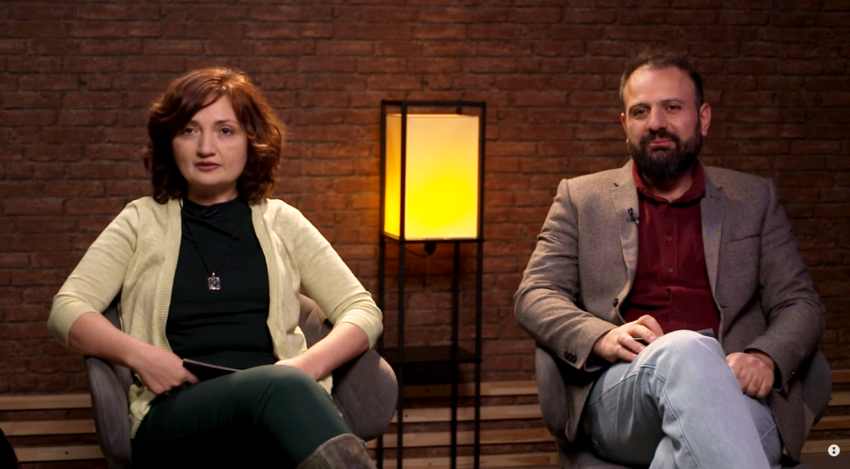
In the “Bard-Mard” (Complex-Human) series, psychologist and sociologist Sona Manusyan, poet Karen Antashyan, and various experts from the humanities and sciences discuss emerging phenomena in our rapidly changing world. This series serves as a compass for the modern individual searching for identity amidst the fog of a deconstructing and reconstructing reality.
Episode 1. Prologue
The series premiere where the hosts introduce the project’s underlying philosophy. Why is the modern individual “complex,” and how do we intend to explore the phenomena that will serve as orientation landmarks in the fog of a deconstructing and reconstructing world?
Episode 2. We are in History
Guest: Davit Mosinyan (Philosopher) This conversation explores the historicity of time and the challenges of self-orientation during breakthrough historical periods. How do we recognize that we are “inside history,” and how does historical time impact our everyday perceptions and identity?
Episode 3. Gene-Deconstruction
Guest: Lilit Nersisyan (Bioinformatician) To what extent is human destiny predetermined by genes? Is there such a thing as an “Armenian gene”? The discussion revolves around modern genomics, the link between humans and their microbiome, and the latest discoveries in Armenian bioinformatics.
Episode 4. The Future of Education and the Education of the Future
Guest: Sona Balasanyan (Sociologist) How are the standards of being “educated” formed in the modern world? We discuss trust in educational systems, intergenerational differences, self-education, and the future expectations that shape our current educational models.
Episode 5. Digitizing Identity
Guest: Meruzhan Karapetyan (Bibliographer) In the digital age, to exist is to be digitized. We discuss the challenges of digitizing Armenian material and intangible cultural heritage, the formation of new online identities, and the challenges of existing as a human in the digital era.
Episode 6. Remembering the Future
Guest: Ani Grigoryan (Psychologist-Researcher) How are the processes of remembering the past and imagining the future interconnected in our brains? We delve into the relationship between memory and identity and how modern technologies are altering individual human memory and behavior.
Episode 7. Planet of Humans from the Future
Guest: Lilit Sahakyan (Ecologist) The crisis in the relationship between humans and nature: Why has the drive for progress led to consumerism and the irreversible disruption of ecosystems? We search for models of rational coexistence between humanity and the planet with a view toward the future.
Episode 8. Solving Complex Problems
Guest: Khachik Nazaryan (Engineering Team Lead at Broadcom) How do technology, economy, and politics intertwine into a single networked reality? The conversation focuses on systemic thinking as a vital skill for the new era and explores how complex, interconnected problems are solved in a high-tech environment.
Episode 9. Language: The Mirror and Architect of Reality
Guest: Hasmik Jivanyan (Linguist, Researcher) Language does not merely describe the world; it shapes it. We discuss the link between language and thought, linguistic power, and the challenges of interacting with AI based on Large Language Models. Who is speaking: us, or language through us?
Episode 10. New Frontiers of Intelligence in the AI Era
Guest: Hrant Khachatryan (Head of the Machine Learning Group at YSU) How does Artificial Intelligence truly differ from human intelligence, and can it ever possess consciousness or “will”? We discuss an algorithm-driven future and Armenia’s place on the global AI map.
Episode 11. The New Economic Order and Armenia
Guest: Karen Zakaryan (Economist, Financier) What kind of economic order is forming amidst wars and the technological revolution? We talk about the future of the dollar, new forms of money, and Armenia’s economic model within the context of global shifts.
Episode 12. Contemporary and Timeless Art
Guest: Vigen Galstyan (Art Historian, Curator) What makes art “contemporary”? A discussion on the evolution of art, the changing role of the author, and AI’s role in creativity. We explore how Armenian reality engages with global trends in contemporary artistic discourse.
